

How Do You Qualify for a DOT Medical Card?
Qualifying for a DOT medical card requires meeting federal health and safety standards related to vision, hearing, blood pressure, physical ability, and overall medical fitness. At Universal Primary Care, our team conducts a thorough DOT physical, reviews your health history, and explains any additional documentation that may be needed to help you complete the certification process. For more information, contact us today or book an appointment. We are conveniently located at 6025 Niles Street, Suite A1, Bakersfield, CA 93306.
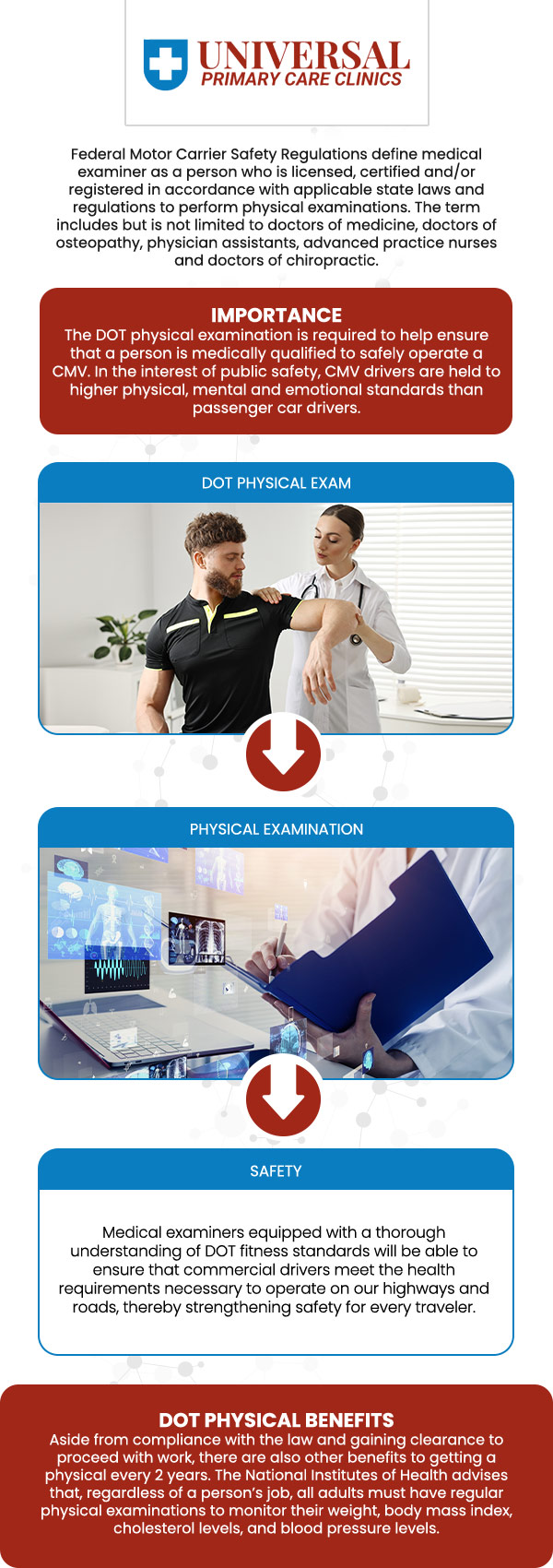
Table of Contents:
What medical requirements must drivers meet for a DOT medical card?
What health conditions may affect DOT medical card qualification?
Are vision and hearing tested during a DOT medical examination?
What documents should drivers bring to a DOT medical card examination?
How long is a DOT medical card valid after approval?
How does our team conduct DOT medical card examinations at Niles Family Medicine?
To qualify for a DOT medical card, a commercial driver must complete a physical examination with a medical examiner listed on the Federal Motor Carrier Safety Administration’s National Registry. The examiner determines whether the driver meets the physical qualification standards for safely operating a commercial motor vehicle.
The examination evaluates vision, hearing, blood pressure, cardiovascular health, respiratory function, neurological health, mental health, and musculoskeletal function. Drivers must generally have at least 20/40 vision in each eye, a horizontal field of vision of at least 70 degrees in each eye, and the ability to recognize red, green, and amber traffic signals. Hearing requirements may be met through a forced-whisper test at five feet or qualifying audiometric results.
At Universal Primary Care, our team reviews each driver’s medical history, current medications, chronic conditions, and supporting records before completing the required examination. Drivers with diabetes, heart disease, vision limitations, sleep disorders, or other health concerns may need additional documentation. When a driver meets the applicable requirements, the certified medical examiner completes the necessary DOT medical certification paperwork.
Health conditions do not always automatically disqualify a commercial driver. The medical examiner considers the severity of the condition, current symptoms, treatment response, risk of sudden impairment, and whether the condition could interfere with safely operating a commercial vehicle. Some drivers may qualify for a shorter certification period, while others may need further evaluation or an applicable federal variance.
Conditions that may affect qualification include uncontrolled high blood pressure, cardiovascular disease associated with fainting or breathing difficulty, significant respiratory dysfunction, epilepsy or other causes of loss of consciousness, and musculoskeletal or neurological limitations that interfere with vehicle control. Certain psychiatric conditions, substance use concerns, and medications that impair alertness or coordination may also affect the examiner’s decision.
Our team can explain which records may be needed and help coordinate documentation from a treating clinician or specialist. The final certification decision is made by the certified medical examiner after reviewing the complete examination and available medical information.
Yes, vision and hearing are required parts of a DOT medical examination because both abilities are important for identifying road hazards, traffic signals, warning sounds, and surrounding vehicles. Corrective lenses and hearing aids may be used to meet the applicable standards, but their required use will be documented on the driver’s medical certificate.
Under the standard vision requirements, a driver must generally have at least 20/40 distant visual acuity in each eye and in both eyes together, with or without corrective lenses. The driver must also have at least a 70-degree horizontal field of vision in each eye and be able to recognize red, green, and amber traffic-control colors. Hearing may be evaluated by determining whether the driver can hear a forced whisper at five feet in the better ear or through audiometric testing showing an average hearing loss of no more than 40 decibels at the specified frequencies.
During a DOT physical at Universal Primary Care, our team performs the required vision and hearing screenings and records the findings on the examination report. Drivers should bring their glasses, contact lenses, or hearing aids to the appointment. When a driver does not meet the standard vision criteria, an evaluation from an ophthalmologist or optometrist and a completed MCSA-5871 form may be required under the alternative vision standard.
Drivers should bring a valid government-issued photo ID, a complete list of prescription and over-the-counter medications, and their current or previous DOT medical certificate when available. They should also bring any glasses, contact lenses, or hearing aids used while driving. Because drivers must complete the medical history section of Form MCSA-5875, accurate information about diagnoses, surgeries, hospitalizations, medications, and previous health concerns should be available.
Additional documentation may be needed for chronic or significant medical conditions. A driver with insulin-treated diabetes must provide a completed MCSA-5870 form signed by the treating clinician within 45 days of the DOT examination. A driver qualifying under the alternative vision standard must provide a completed MCSA-5871 form from an ophthalmologist or optometrist.
Bringing complete documentation to Universal Primary Care may help the certified medical examiner decide without unnecessary delays. Because the required records depend on the driver’s medical history, our team recommends contacting Niles Family Medicine before the appointment when there is a history of diabetes, heart disease, sleep apnea, seizures, vision limitations, hearing loss, or another condition requiring ongoing monitoring.
A DOT medical certificate may be valid for up to 24 months from the date of the examination. This is the maximum certification period rather than a guaranteed duration for every driver. The medical examiner determines the appropriate certification length after reviewing the driver’s examination results, medical history, treatment, and need for continued monitoring.
A certificate may be issued for less than two years when a medical condition requires more frequent evaluation. For example, high blood pressure, heart disease, diabetes, sleep disorders, or another monitored condition may lead to a shorter certification period. Drivers qualifying under the insulin-treated diabetes standard or the alternative vision standard generally require medical examination and certification at least annually.
Our team encourages drivers to review the expiration date on their medical certification and schedule recertification before it expires. Planning allows time to obtain updated laboratory results, specialist reports, treatment records, or required FMCSA forms.
A DOT medical card examination at Niles Family Medicine begins with a detailed review of the driver’s medical history, current medications, chronic conditions, previous surgeries, and symptoms that could affect commercial driving. The examination is performed by a medical examiner listed on the FMCSA National Registry, and the driver completes the medical history portion of Form MCSA-5875.
The physical examination includes blood pressure and pulse measurements, vision and hearing screenings, and an assessment of the cardiovascular, respiratory, neurological, and musculoskeletal systems. This routine urinalysis is not the same as a DOT drug or alcohol test, although medications and substance use are reviewed as part of determining medical qualification.
After the examination, the certified medical examiner reviews all findings and supporting records to determine whether the driver meets FMCSA requirements. If the driver qualifies, the required medical certification documentation is completed. When additional records or testing are needed, the examination may be placed in pending status, and the requested information generally must be provided within 45 days. Universal Primary Care supports drivers at Niles Family Medicine with documentation guidance, follow-up care, and future recertification planning. For more information, contact us today or book an appointment. We are conveniently located at 6025 Niles Street, Suite A1, Bakersfield, CA 93306. We serve patients from Bakersfield CA, Maltha CA, Kayandee CA, Panama CA, Arvin CA, Fairfax CA, Rosedale CA, and surrounding areas.
Check Out Our 5 Star Reviews



Additional Services You May Need
▸ Annual Physical Exam
▸ COVID-19 Testing
▸ Chronic Disease Management
▸ Vaccinations
▸ STD Testing
▸ Primary Care
▸ Influenza (Flu)
▸ Common Cold
▸ Asthma
▸ Medical Weight Loss
▸ Diabetes
▸ School Physicals Exam
▸ Sports Physicals
▸ EKG
▸ Geriatric Care
▸ View All Services


 Send Text
 How May I Help You?